The Effect of Extensible Business Reporting Language Adoption, Continuous Auditing on Auditors' Attention to Fraud Cues: A Field Study
Article Sidebar
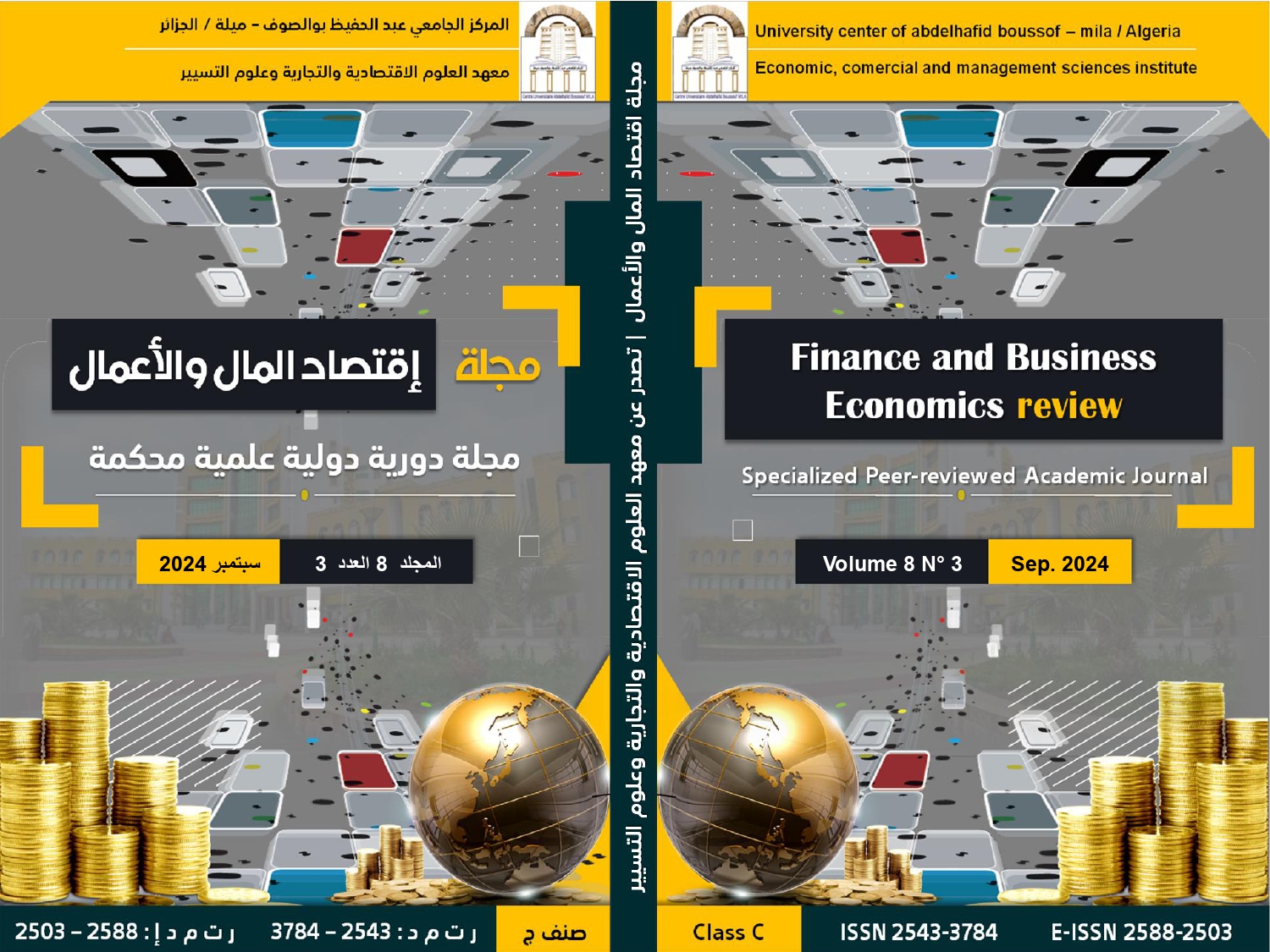
Main Article Content
Abstract
This study aims to examine the effect of continuous auditing, XBRL language adoption on auditors’ attention to fraud cues. we designed a quantitative model based on an online survey conducted among 96 external auditors to provide evidence in the Algerian context. The data were analyzed using SPSS version 26. The findings indicate that continuous auditing, XBRL language adoption have a significant influence on auditors’ attention to fraud cues. The results also indicate that the implementation of continuous auditing based on XBRL language adoption have a significant influence on auditors’ attention to fraud cues. we confirm that the digitalization of the audit process is extremely important, especially in the integration of continuous auditing and XBRL language to combat the growing prevalence of fraudulent behaviors.
Article Details
References
Abbassi, S., Zanouda, I., & Chaoubi, M. F. Using the ARDL to Interpretation of the relationship between accounting fraud and tax risk in High tech companies Case study ALI BABA Group (2007-2020), 11(1), pp.756-776.
al-masoodi, h. a., yousif. (2021). Adopting Extensible Business Reporting Language (XBRL) in financial statement to improve quality of financial reporting. Warith Journal of Scientific Research, 3(1). Pp.154-179.
Alles, M., Kuenkaikaew, S., & Littley, J. (2012). The acceptance and adoption of continuous auditing by internal auditors: A micro analysis. International Journal of Accounting Information Systems, 13(3), pp.267-281.
Antonio, G. R. (2014). Continuous auditing: Developing automated audit systems for fraud and error detections. Journal of Economics, Business, & Accountancy Ventura, 17(1), 127-144.
Austin, A. A. (2023). Remembering fraud in the future: Investigating and improving auditors' attention to fraud during audit testing. Contemporary Accounting Research, 40(2), pp.925-951.
Benbouali, K., & Berberi, M. A. (2018). XBRL As Process to Improve The Quality of Information and Efficiency of The Stock Market in North African Countries. el-Bahith Review, 18(1), pp.583-598.
Braun, R. L. (2000). The effect of time pressure on auditor attention to qualitative aspects of misstatements indicative of potential fraudulent financial reporting. Accounting, Organizations and Society, 25(3), pp.243-259.
Charlton, G., & Marx, B. (2009). An investigation into the impact of continuous auditing on the external auditors of the four largest banks in South Africa. South African Journal of Accounting Research, 23(1), pp.45-65.
Cong, Q., Huang, Z., & Hu, J. (2013). A collaborative computer auditing system under SOA-based conceptual model. Fifth International Conference on Machine Vision (ICMV 2012): Algorithms, Pattern Recognition, and Basic Technologies,
Du, H., & Roohani, S. (2007). Meeting challenges and expectations of continuous auditing in the context of independent audits of financial statements. International Journal of Auditing, 11(2), pp.133-146.
Eissa, H., & Assaf, S. F. M. (2022). Auditors’ perceptions of the continuous auditing role in mitigating audit risks in Egypt during the Corona pandemic–An Experimental Investigation. Alexandria Journal of Accounting Research, 6(3), pp.1-68.
Eni, L. C. (2013). Considerations on the use of XBRL during the financial audit missions: Approach of a model. Economic Computation & Economic Cybernetics Studies & Research, 47(3). pp.17-36.
Gonzalez, G. C., & Hoffman, V. B. (2018). Continuous auditing's effectiveness as a fraud deterrent. Auditing: A Journal of Practice & Theory, 37(2), pp.225-247.
Hamdan, M. N., & Al-olimat, N. H. (2021). Reducing The Challenges of (Caats) In Light of Covid-19 And Its Impact On Audit Evidence:(Xbrl) As A Mediating Variable. Academy of Accounting and Financial Studies Journal, 25, pp.1-12.
Hoffman, C., & Rodríguez, M. M. (2013). Digitizing financial reports–Issues and insights: A viewpoint. The International Journal of Digital Accounting Research, 13(1), pp.73-98.
Ilias, A., Ghani, E., & Azhar, Z. (2017). XBRL adoption in Malaysia: Perception of the accountants and auditors. International Conference on Accounting Studies, pp.86-95.
Larson-Hall, J. (2015). A guide to doing statistics in second language research using SPSS and R. Routledge.
Li, Y., Rogé, J. N., Rydl, L., & Hughes, J. (2007). Achieving Sarbanes-Oxley compliance with XBRL-based ERP and continuous auditing. Issues in Information Systems, 8(2), pp.430-436.
Moreira, J. R. P., & da Silva, P. C. (2013). A management model for integrating SOA and XBRL. The International Journal of Digital Accounting Research, 13(19), pp.123-150.
Öhling, A., & Heitmann, S. (2006). Audit of the Future-An Analyis of the Impact of XBRL on Audit and Assurance. rapport nr.: Master’s Thesis(2005).
Raja, J., & Ramakrishnan, M. (2017). Implementing continuous auditing and compression technique in log auditing. 2016 Eighth International Conference on Advanced Computing (ICoAC),
Saleem, K. A. (2024). The Impact of Continuous Auditing on Financial Fraud: A Qualitative Study of Jordanian Industrial Enterprises. Migration Letters, 21(3), pp.577-589.
Segal, S. (2016). Accounting frauds–review of advanced technologies to detect and prevent frauds. Economics and Business Review, 2(4), pp.45-64.
Shan, Y. G., & Troshani, I. (2014). Does XBRL benefit financial statement auditing? Journal of Computer Information Systems, 54(4), pp.11-21.
Silva, P. C. D., Luciano, J. G., & Peres, C. B. (2022). Continuous auditing supported by XBRL: an application on the Brazilian public digital bookkeeping system. International Journal of Business Innovation and Research, 27(2), pp.143-165.
Zimbelman, M. F. (1997). The effects of SAS No. 82 on auditors' attention to fraud risk factors and audit planning decisions. Journal of accounting research, 35, pp.75-97.